The Guru's daughter and the Boy on a mission
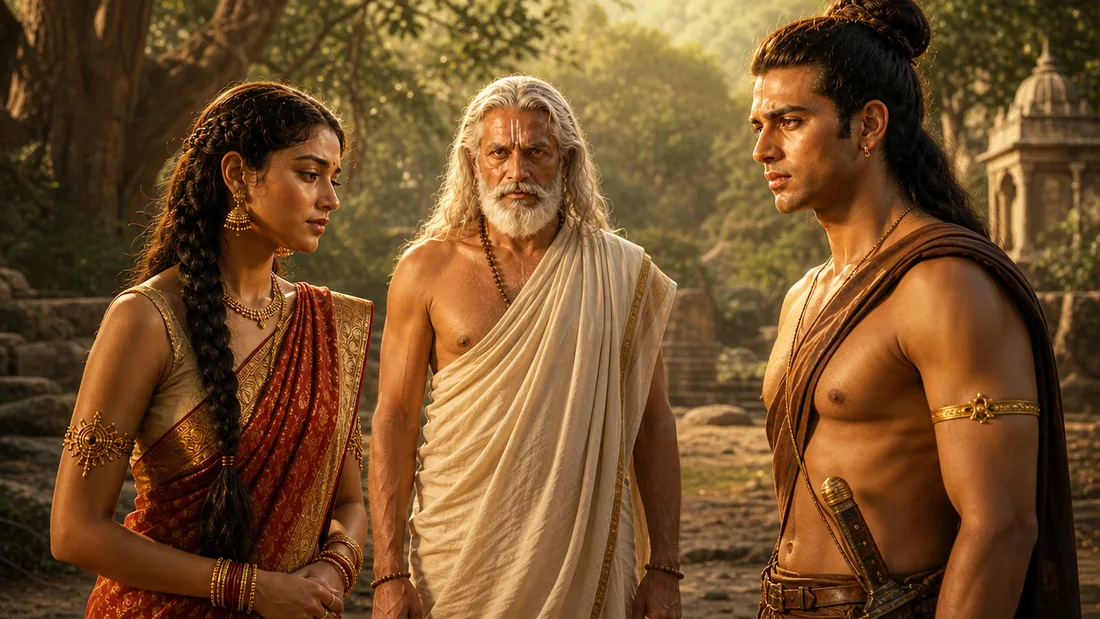
In the age when gods and asuras still fought over the ownership of everything, there lived a teacher who knew the sacred words that death obeyed.
His name was Shukracharya (शुक्राचार्य). He counselled the asuras. Another great teacher, Brihaspati (बृहस्पति), counselled the gods. He was their guru, wise beyond his years. Between the two teachers, gods and asuras knew everything worth knowing, but Shukra knew a thing more. He held the Sanjivani Vidya, the sacred words which called the dead back into their bodies. So when an asura fell in battle, Shukra spoke the sacred words and the asura rose, dusted himself off, and picked up his weapon again. However, when a god fell, they stayed fallen.
The gods saw where this equation would end. They had no other move left, and they knew it. So they called upon Brihaspati's son, a young man named Kach (कच). He was well made, well spoken, the kind of student teachers quarrel over.
Go to Shukracharya, they told him. Ask to be his student. Serve him until the sacred words are yours, however long it takes. There is a daughter in that house, they said, dearer to her father than his own breath. Win her kindness, and the rest will follow. They were not proud of it but it was the only way.
Kach walked to the gates of his father's enemy and stood before the teacher. He did not hide who he was. "I am Kach", he said. "Son of Brihaspati, grandson of Angiras (अंगिरस्). Take me as your student and I will serve you a thousand years."
Shukra took him in despite knowing whose son stood before him. That is the law a teacher keeps, older than any war: the one who knocks at the door of knowledge cannot be turned away.
"Stay, then. Tend my fire and my cattle, and we will see what a thousand years makes of you". Shukra said.
Devayani (देवयानी), the daughter, was a Brahmin girl raised among the asuras, the only child of her own kind in that whole city. She kept the fire. She counted the cattle. That was her whole world, and she did not know to want another. Into that quiet house walked a boy carrying flowers. He was her own age, kind, courteous, with a thousand years of time on his hands.
He fetched wood. He walked the cattle out at dawn. He learned which flowers she liked and brought them at the hour she liked them. He sang and danced for her. She never asked him why he had come. He never told her. Five hundred years passed and they came close, got used to each other.
The asuras, however, saw him for what he was. A threat, patient and well-mannered, sent to steal the one thing that kept them ahead of the gods. And they knew Shukracharya would do nothing to stop him. A teacher does not turn on his own student. Not even this one.
So they took matters into their own hands. On a day Kach grazed the cattle alone, they found him in the forest. "You know why we have come," one of them said. Kach did not run. "I know," he said, and that was the last thing he said that day.
They killed him, cut him fine as sesame, and fed him to the Shalavrikas, the half-wild dogs that keep the border between the village and the forest beyond it.
At dusk Devayani was waiting at the gate as usual. When the cattle came home alone without the herdsman, she ran to her father.
"The lamps are lit," she told him. "The sun is down. The cows are back and Kach hasn't returned. I will not live without him."
Shukra heard what she was really asking, and being the doting father he was, did not argue. He simply spoke the sacred words. And out of the dark between the trees, out of the bellies of the Shalavrikas, Kach came back. Whole. Smiling, a little.
Again the next morning, he walked under the trees, basket in hand. He had died once, and remembered it. He had been called back once. That did not mean he would be saved again. It only meant he knew, now, exactly what dying felt like, and he went anyway. That was his duty, and he kept at it. And it happened again. The asuras were waiting, patient as they had learned to be. They killed him, cut him fine as sesame, and fed him to the Shalavrikas. But Shukra brought him back, the same as before, at his daughter's request.
The asuras finally understood what their real problem was. As long as Shukra was willing to call him back, no death would hold him, not in the forest, not under any sky. What they needed was a death without an address, a death that Shukra could not undo.
So the third time, they changed the method. They burned him first, ground him to ash, and stirred the ash into Sura (सुरा) (a strong, traditional alcoholic drink brewed from fermented grain or rice meal). Then they carried the cup to their own teacher and asked him to celebrate with them. Shukra, who trusted his own students, thought nothing of it. He drank, not knowing he was drinking his own student.
Devayani came to the gate the third time, with the same words. "Kach went for flowers," she said. "He is nowhere."
Shukra sighed, an old man tired of the same fear. "Let it rest, child," he said. "I call him back and they only kill him again. Why mourn a student?"
"He is the son of Brihaspati," she said. "Grandson of Angiras. An ocean of merit." Then she said the thing she had held back the first time. "I will not eat. I will follow where he has gone. He is dear to me."
Shukra gave in and called the sacred words again. But this time, the answer came from inside his own body. "I am here," said the voice, quietly, from his belly. The teacher asked how he remembers who he is. "By your grace, I remember it all," Kach said. "I remember everything that was done to me, and how. Killed. Burned. Ground fine. Poured."
Shukra turned to his daughter. "You must choose," he said. "It is him, or it is me." She did not answer quickly. Whichever way she leaned, she was choosing which man would live.
"I want you both," she said at last. "Please find a way."
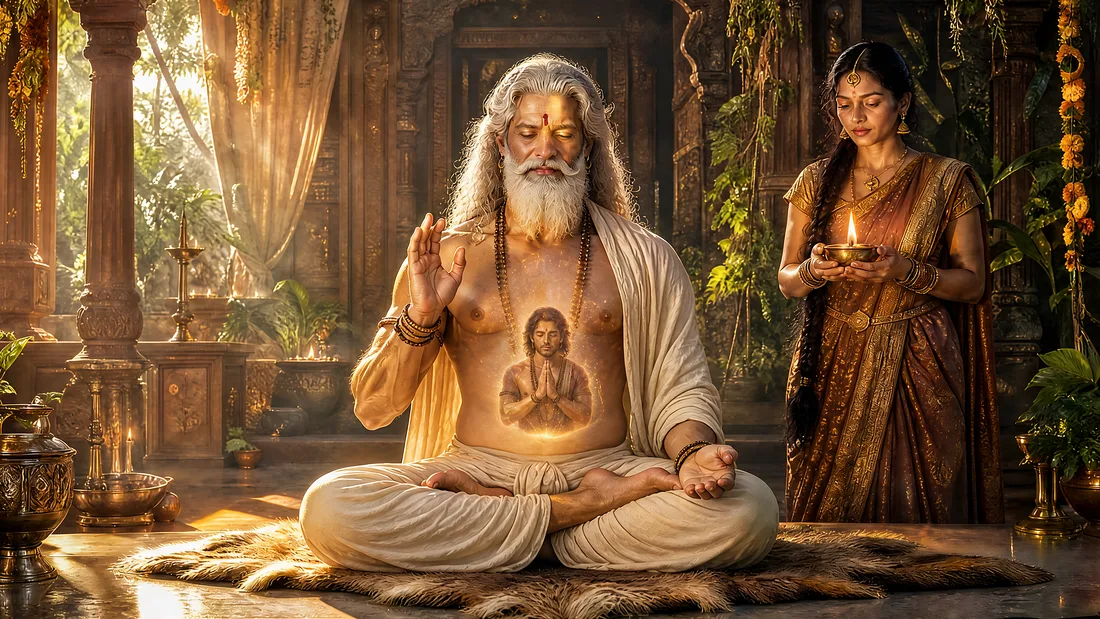
There was only one way, and it meant trusting the boy he was about to tear open himself for.
Shukra taught Kach the sacred words while he was still inside — teacher and pupil sharing a single pulse. And Kach was born a third time, at a cost to the body that carried him. His teacher. He stood and without hesitation, spoke the sacred words over his own teacher. Afterall, he was his Guru. His mentor.
Shukra sat up among the wine cups, looked at the wine and realized it is the root cause that led to all this. Some say this is why Shukra, as a planet, is read as disliking wine and excess of it in a chart. Why a troubled Venus so often shows itself in a person's relationship with drink. Because what a thousand years of penance to lord Shiva (शिव) had won him, he lost in a single night. So much so that he had to lose his own life and place trust in someone else to save himself.
As for the Asuras, no god ever defeated the asuras in this. They defeated themselves. To hide a dead man from the one voice death obeys, they hid him inside that voice itself. It was the most careful thing they ever did, and it is what sent the sacred words out the gate for good. Cleverness like that does not fail by accident. It fails by working exactly as intended, one step further than the ones who built it could see.
Kach had gotten what he had set out to achieve and he was ready to return home triumphant. But as he stood at the boundary of the ashram, Devayani, confident of her love, asked him to be hers. "Take my hand with the proper mantras. You know what I have been to you."
But she wasn't prepared for what she was about to hear. "You are my teacher's daughter," he told her. "You are what he is to me. Someone to worship. Not someone to take." And then he paused, the way one pauses before they have something harder to say. "And besides, I have lived inside your father's body, and have been born of it. This makes me his son and you my sister." That was the truth, the law.
Something in her face changed as he spoke. She had called him back from death thrice, and asked her father for nothing else in return. Now she was being handed a brother's love, when she was ready to give him everything a wife gives. She did not shout. She did not weep. She answered him instead.
"What you took so many years to achieve, and died thrice to carry," she said, "will be barren in your mouth when you need it the most. The sacred words will fail you."
"Then it will answer to whoever I teach," he said, calmly, accepted her curse, and turned to go.
Whether he loved her, no one would ever know for certain. Whether walking away cost him everything or cost him nothing, the story does not say either. But one thing is clear — Whether he meant to hurt her or not, he hurt her all the same. So many years of service. Three deaths survived. The sacred words were finally learnt. None of it undid the one thing she asked for and did not get.
Perhaps that is the real inheritance he carried out the gate. But he was a man on a mission, and he finished it, and went home. That is the story of the boy who did it all for Dharma. Probably one of the first spies the world ever had.
This is who Shukra is, and why he enters a chart
Astrologers call Shukra (the planet Venus) impartial, the significator of wife, luxury, conveyance, property and so much else that is good, and, most important of all, the one who can resurrect the dead, metaphorically of course. This story is why.
Shukracharya knew whose son had knocked at his gate. He did not let it matter. He let an enemy's boy stay, and taught him anyway. He is impartial.
He also carries this: that love sometimes asks you to tear yourself open for the one you love, and there is no way around it, only through it. Shukra did not choose that lesson. His daughter's grief chose it for him. He had to tear himself open because she left him no other choice, and some say that is the truest thing a chart can show. The moment love asks for more than you meant to give, and you give it anyway.
And finally, Shukra carries the sanjivani itself, the power to call the fallen back. Read as Venus, this is why it governs the body's resilience, the strength to rise again after the hardest times and from the weakest bodies. The power to stand back up as many times as it takes.
Whether any of this is really written into a planet, no one can say. But the old sages watched the brightest thing in the evening sky, the one that dies into the sun's glare and comes back as the morning star, and they gave it this story.
That is our Venus.